
If you have been investing in syndications for a while, from time to time you may across the term preferred equity or preferred equity partner. Perhaps you have not encountered this term before but may be curious about what it really means. In today’s quick snippet we’ll demystify just that, discuss some pros and cons, and share a couple of mitigating factors, so you can make an informed investment decision if or when you come across an investment structure that includes preferred equity.
But first, let’s answer the question: What is preferred equity?
Preferred equity typically comes in the form of a large check contributing material part of the capital in a deal. It is most commonly provided by an institution, high net worth investor, or a family office. And as the “preferred” name implies, it not only ranks higher in the capital stack in terms of priority (see infographic below), but also carries preferred terms (in terms of preferred rate, voting powers, and potentially decision making).
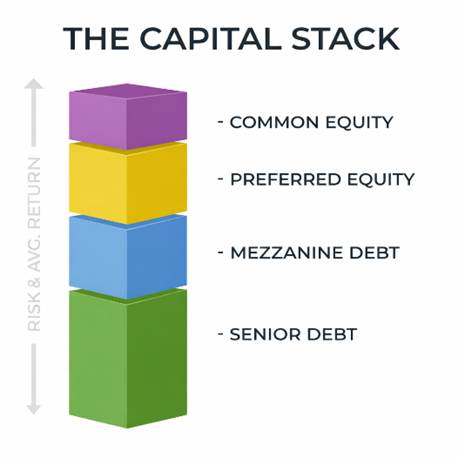
Why would one consider preferred equity after all? There are a couple of benefits:
First, it comes in the form of a large check from a single investor/institution with deep pockets, which makes raising the capital a lot easier (and sometimes faster). In addition, the preferred equity investors are typically experienced and can bring additional expertise to the deal as well as additional liquidity, if needed (there are strings attached with that of course). Lastly, they provide institutional level oversight, which would enforce better reporting, communication, and operational discipline.
With all that, why would one decline or be concerned about having a preferred equity partner? A couple of drawbacks to consider include:
Given the size of their equity participation and voting/decision making rights, the preferred equity partners may exercise undue influence on the deal to protect their investment and their rights. Such influence may not always be in the best interest of the passive investors (common equity, LPs). In addition, the preferred equity partner may walk away last minute with adverse consequences for the LPs. For example, they may determine last minute that they will only contribute 50% of the originally discussed check amount, leaving the syndicators to raise the rest at the eleventh hour. If the syndicators are unable to do so and still choose to close, it exposes the deal and the LPs at risk (e.g. not being able to raise the capex and operating reserves). Another disadvantage to having a preferred equity partner is potential return dilution for the LP, especially when the preferred equity partner comes after close or if the preferred equity partner takes over the deal in a downside scenario. Lastly, such large checks usually come with strings attached that may or may not be in the best interest of the LPs.
Given the potential downside, how can one mitigate the risks involved with having a preferred equity partner?
It is important to understand the following:
- The terms of the agreement between the GPs and the preferred equity partner.
- Who the preferred equity partner is and their transaction (behavior) history.
- The economics of the deal.
It is also important for LPs to recognize that you are entering a deal with essentially three key decision makers – the lender first, the preferred equity partner second, and the operator third.
Ultimately do not move forward, if you are not comfortable with this and do not think the mitigates are sufficient. The beauty of investing is that you always have a choice whether to proceed or not, after you complete your own due diligence, recognize and analyze the risks involved, and understand (and get comfortable or not) with the downside.
Vessi Kapoulian
Peeling back the layers of passive real estate investing, so you protect the downside and invest with clarity and confidence.
Disclaimer: The information presented does not constitute legal, accounting, tax, or individually tailored investment advice. Past results do not represent or guarantee future performance.
P.S. You are reading this on the web or social media. I also send a direct email edition that carries more: additional teaching notes, access to special events, and periodic subscriber bonuses. If you would like that version, you can subscribe here.